Echoes of Change: Civic Expression through Poetry
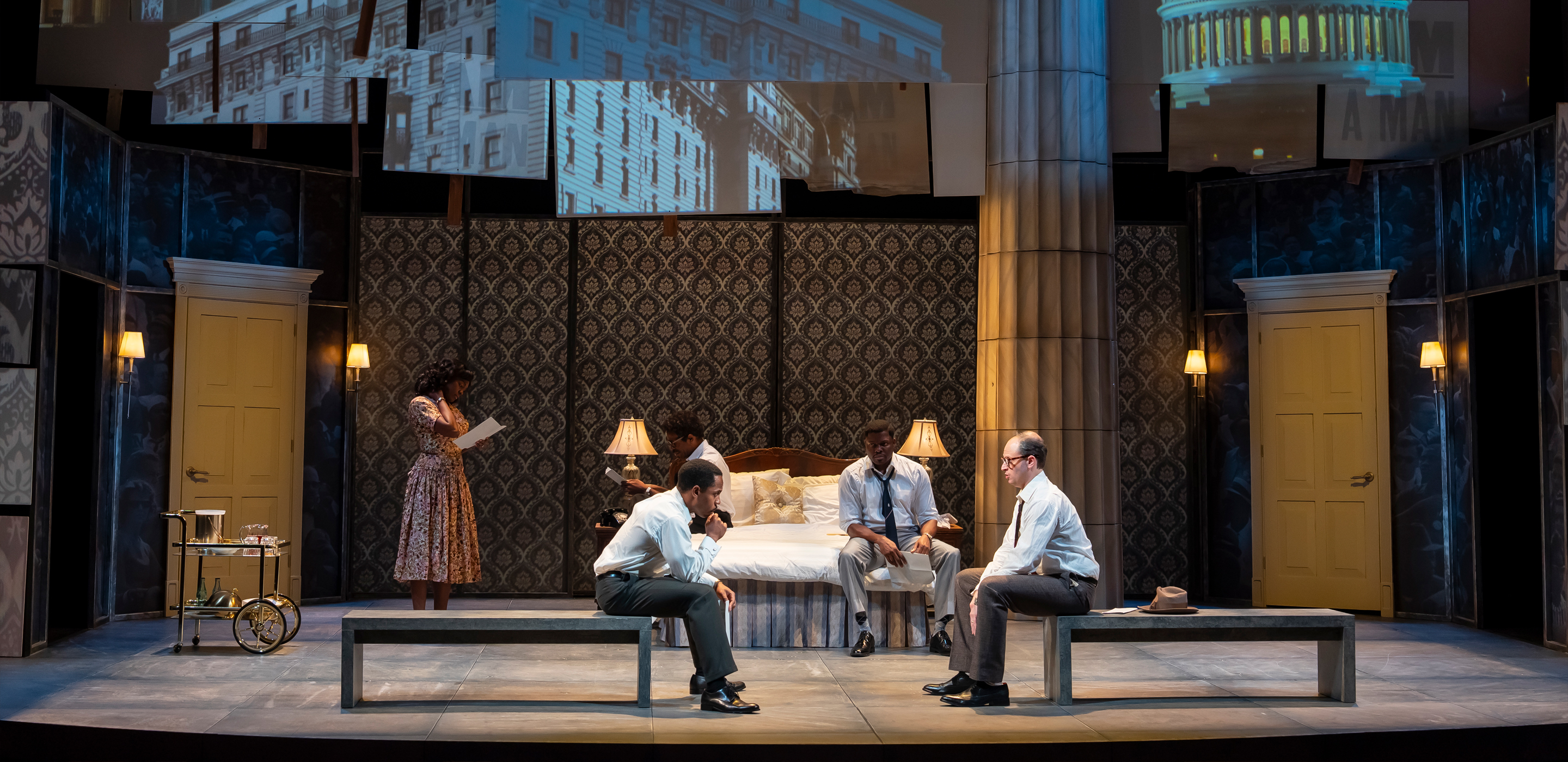
In The American Five, five collaborators with differing perspectives join forces to help craft Dr. Martin Luther King Jr.’s historic “I Have a Dream” speech. Their process mirrors the heart of democracy—messy, passionate and deeply human. In this workshop, educators will step into that collaborative space, using theatre and slam poetry techniques to explore how art can amplify civic engagement. Through hands-on activities, you’ll experience the transformative power of ensemble work and learn strategies to bring these skills into your own classroom. Together, we’ll move from protest to poetry, blending history, artistry and activism into one compelling lesson plan.
Learning Objectives
- Build connections between Dr. Martin Luther King Jr.’s “I Have a Dream” speech and modern forms of protest poetry/spoken word.
- Collaborate in groups to create original poems that reflect civic issues using rhetorical and poetic devices.
- Incorporate rhythm and performance strategies to enhance the impact of spoken word pieces.
- Reflect on the role of art in civic engagement, considering how performance can amplify community voices and democratic ideals.
- Demonstrate ensemble skills by performing collaboratively and giving constructive feedback to peers.
Key Terminology
- Repetition – repeating words or phrases for emphasis and rhythm.
- Alliteration – the repetition of consonant sounds at the beginning of words.
- Metaphor – a figure of speech comparing two unlike things without using “like” or “as”.
- Simile – a comparison using “like” or “as”.
- Imagery – descriptive language that appeals to the senses
Video Resource
Teachers, please preview the videos and select the one that works best for your classroom.
- Darius Simpson & Scout Bostley – Lost Voices
- Changing the World, One Word at a Time! | The Queen Latifah Show
Online Resources
Day 1: Poetry as Civic Voice
Ask your students: Have you ever heard a poem or song that made you stop and really think about the world? Protest poetry is exactly that—it’s art that calls for change. Today we’ll watch a recording of a spoken-word poetry performance and explore how poets use words, rhythm, choreography and emotion to speak truth to power.
1. Warm-Up (10 minutes):
- Quick brainstorm: What’s a problem in your school, community, or the world that you’d like to change? Write student responses on the board.
- Tell students: Poets often take those same issues and turn them into art to amplify their voices.
2. Introduction (15 minutes):
- Show video: Lost Voices (Darius Simpson & Scout Bostley – Lost Voices) OR Somewhere in America (Changing the World, One Word at a Time! | The Queen Latifah Show)
- First viewing: watch/listen only.
- Second viewing: ask students to jot down words, phrases, movements or feelings that stood out.
- Discussion:
- What issues are these poets raising?
- What poetic tools did you notice? (repetition, rhythm, imagery, etc.)
- How does using more than one voice in the performance change the impact?
- Chart responses under two headings: Poetic Tools and Civic Messages.
- Discussion:
3. Mini-Lesson (15 minutes):
- Introduce key terms: repetition, metaphor, imagery, alliteration, simile.
- Handout a short excerpt of MLK’s “I Have a Dream.” Treat it as poetry, not just speech. Ask: Do you hear the same poetic tools?
- Example | “Let freedom ring from the prodigious hilltops of New Hampshire. Let freedom ring from the mighty mountains of New York. Let freedom ring from the heightening Alleghenies of Pennsylvania. Let freedom ring from the snowcapped Rockies of Colorado. Let freedom ring from the curvaceous slopes of California. But not only that; let freedom ring from Stone Mountain of Georgia. Let freedom ring from Lookout Mountain of Tennessee. Let freedom ring from every hill and molehill of Mississippi. From every mountainside, let freedom ring.”
- Devices:
- Repetition: Repetition of “Let freedom ring.”
- Imagery: Vivid landscapes spanning the entire country.
- Devices:
- Example | “Let freedom ring from the prodigious hilltops of New Hampshire. Let freedom ring from the mighty mountains of New York. Let freedom ring from the heightening Alleghenies of Pennsylvania. Let freedom ring from the snowcapped Rockies of Colorado. Let freedom ring from the curvaceous slopes of California. But not only that; let freedom ring from Stone Mountain of Georgia. Let freedom ring from Lookout Mountain of Tennessee. Let freedom ring from every hill and molehill of Mississippi. From every mountainside, let freedom ring.”
4. Wrap-Up (5 minutes):
- Exit ticket question: If I wrote a protest poem today, it would speak about…
Day 2: Writing Our Protest Poems
Today students will collaborate in groups to draft their own protest poems using civic issues that matter to them.
1. Warm-Up (5 minutes):
- Teacher sets the scene:
“Today, we’re going to practice turning everyday situations — and civic issues — into poetry. I’ll call out a line that sounds like something you might want to raise awareness about or change. First, you’ll write a simple response in your own words. Then, I’ll introduce a rhetorical device — like alliteration, repetition, metaphor, simile, or imagery — and you’ll use it to transform your response into a poetic line. Finally, we’ll put it all together in a call-and-response.”- How it works:
- Teacher gives the “Call.”
- Students take one minute to jot down their own response.
- Teacher then introduces a rhetorical device for students to apply, rewriting their response in a more poetic way.
- Teacher repeats the “Call,” and students share their responses aloud using their revised language.
- Examples:
- Teacher: “This Friday, a test will be waiting for you to take…”
- Students: “I hate having heinous, hazardous homework and tests!” (alliteration)
- Teacher: “At lunch, the food is bland and gray…”
- Students: “Like ashes served on a plastic tray!” (simile/imagery)
- Teacher: “On the bus, the seats are broken and torn…”
- Students: “We rise, we rise, we rise — until they’re restored!” (repetition/chant)
- Teacher: “The planet is heating faster than before…”
- Students: “The earth sweats heavy, drowning in its own breath.” (metaphor/imagery)
- Teacher: “This Friday, a test will be waiting for you to take…”
- Tips for facilitation:
- Start light and funny (tests, cafeteria food).
- Then shift into bigger civic ideas (climate, justice, peace).
- Encourage group responses — students can echo one another, build on lines, or shout overlapping responses.
- Modification: This call-and-response style benefits quick thinkers and students already comfortable with the terminology. For others, provide processing time: after showing the examples, write prompts on the board and give students 3–5 minutes to generate responses before running the call-and-response as a group.
- How it works:
2. Group Writing (30 minutes):
- Students form ensembles of 2–5.
- Introduce sentence stems for protest poems:
- “I have a dream…”
- “Somewhere in America…”
- “One day we will…”
- Remind them to use at least 2 poetic devices (repetition, imagery, metaphor, simile, alliteration).
- Each student should contribute lines to the poem. They can alternate writing lines, or they can respond to the prompt separately and then work to combine their texts together into one whole.
- The poem can be as long or as short as needed to communicate the issue they want to address and their ideas about what change they would like to see and its impact on their community.
- Begin drafting group poems, testing lines aloud with rhythm and shared voices.
3. Sharing Drafts (10 minutes):
- Each group shares 2–3 lines of their draft. Audience snaps and names a device they hear.
Day 3: Silhouettes of Change — Rehearsal and Ensemble Technique
Overview:
Online Resource: Teaching Oratory – Ford’s Theatre
Students will move beyond writing into physicalizing their poetry, experimenting with silhouettes and stage pictures that give their words visual power. This helps deepen performance skills and ensemble awareness while preparing for the culminating showcase.
Bringing words to life is not only something that can be done with the voice but also by introducing movement. Simple movements, shapes and gestures can add a powerful layer to a performance. These are images that we see reflected back to us in our everyday lives. We are going to explore some of those images together with a quick exercise.
1. Warm-Up (10 minutes): “Voices into Shapes”
- Teacher calls out civic or justice-related words (e.g., justice, freedom, silence, voice, power, peace).
- Students quickly create a frozen pose or silhouette with their bodies that represent the word.
- Reflect together: What made some shapes feel powerful? Was it the size, the clarity or the emotion?
2. Main Activity (20 minutes): “Poetic Silhouettes”
- Allow each group a few minutes to review their first drafts and make adjustments as necessary.
- Each group chooses one strong line from their poem.
- As a group, they brainstorm what image, action or feeling the line creates.
- Example: “We rise together” → the group forms a rising mountain shape.
- Example: “Our voices are caged birds” → one student crouches as the “bird,” others form the cage.
- Students create a frozen silhouette that represents the line.
- Perform the line while holding the silhouette for 3–5 seconds.
- Repeat with 2–3 more lines, experimenting with unison shapes, solo statues or transitions from one silhouette to another.
3. Extension (10 minutes): Linking Images
- Groups string their silhouettes together into a mini “movement poem.”
- Example: Line 1 = crouched cage → Line 2 = hands breaking bars → Line 3 = rising mountain.
- Encourage them to add rhythm (claps, snaps) or echoing lines between transitions.
4. Wrap-Up (5 minutes): Reflection
- Ask: How does embodying your words in shapes change the way you feel them? How might an audience experience your poem differently when they see both the words and the images?
Day 4: Culminating Performance — Protest to Poetry Showcase
This is the performance day — the culmination of the week’s work.
1. Setting the Stage (5 minute):
- Arrange the classroom like a performance space.
- Teacher frames: Today, we share our civic voices through poetry.
2. Performance (30 minutes):
- Each group performs their poem.
3. Reflection (10 minutes):
- Whole-class discussion: How did it feel to perform your civic message?
- Journal Prompt: What did you learn about poetry’s power to inspire change?
- Option: Share reflections with the group as a closing circle.
Grade Level: adaptable (6 to 12)
Curriculum Connections:
- Language Arts: Rhetorical Devices, Persuasive Writing, Oral Presentation, Theme Analysis
- Theatre/Drama: Ensemble Collaboration, Performance Techniques, Dramatic Interpretation
- Social Studies/History: Civil Rights Movement, Democratic Principles, Civic Engagement, Historical Context