

Step Into Victorian England: The World of A Christmas Carol at Ford’s Theatre
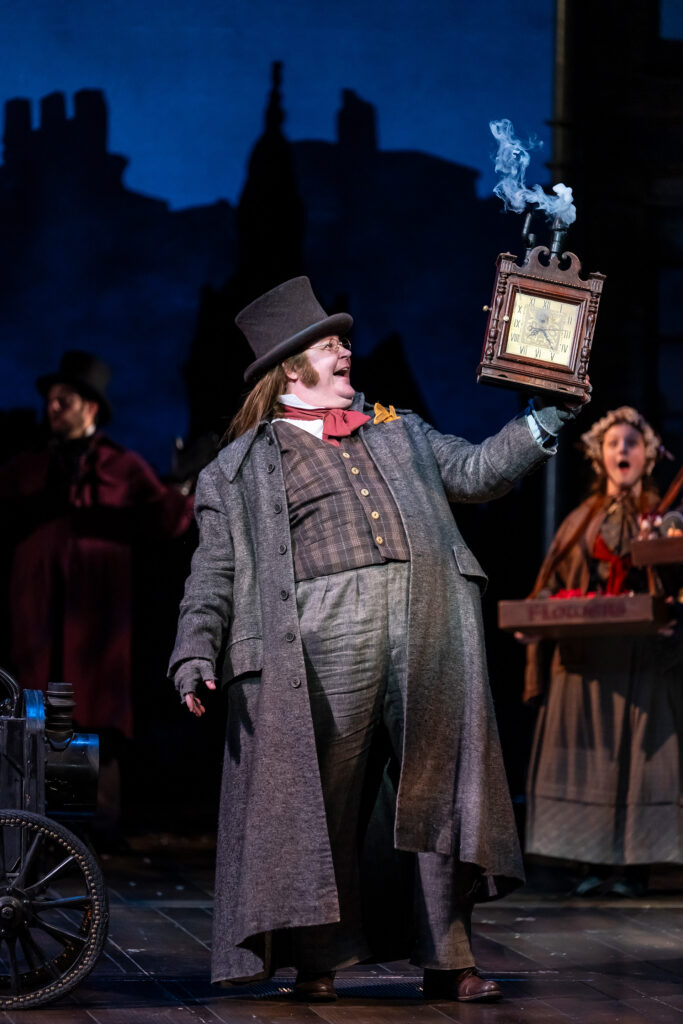
For more than 40 years, Ford’s Theatre’s A Christmas Carol has transported audiences straight to Victorian England. From the Clock Vendor’s cart to Mr. Fezziwig’s suit, every detail of the production is designed to capture the magic and atmosphere of Christmas in the 1800s.
As soon as you step into the theatre, you’re immersed in the world of Dickens’s London. The magnificent sets evoke an era on the cusp of transformation—when England was shifting from a rural, agricultural society to a bustling, industrial one. Scenic designer Lee Savage’s masterful design captures both the beauty and the hardship of the period, contrasting Scrooge’s stately home with the dark alleys where Ignorance and Want are first revealed. Through this visual storytelling, we see the stark divide between the wealthy and the poor that defined life in Victorian England.
Costume designer Alejo Vietti brings this world to life through clothing that tells its own story. In the Victorian age, fashion was as much a marker of class as it was of style. Women typically wore a corset over a shift, topped with a skirt and bodice or blouse. Wealthy women favored structured, tightly fitted garments made from fine fabrics, while working-class women dressed more simply, with fewer layers and plainer materials. Men, too, followed class distinctions in dress—upper-class gentlemen in long coats, waistcoats and top hats; working men in shorter jackets and bowler hats.
Many of the Christmas traditions seen throughout A Christmas Carol will feel familiar to today’s audiences—and much of that is thanks to the British royal family. Queen Charlotte first introduced the decorated evergreen tree to England in 1800, a tradition later popularized by Queen Victoria and Prince Albert, who delighted in decorating their own tree each holiday season. At that time, Christmas trees were adorned not with electric lights, but with flickering candles, fruits and sugar plums.
Toward the end of the play (spoiler alert!), the Cratchit family enjoys a goose for Christmas dinner—an indulgence that became a cherished holiday custom during the Victorian period. Once again, Prince Albert and Queen Victoria helped popularize this festive feast. And of course, no Christmas meal would be complete without Mrs. Cratchit’s famous pudding. Made with dried fruit and soaked in brandy before being set alight, the flaming pudding was a true centerpiece of Victorian celebration—one that endures today.
Gift-giving also began to take shape in this era. Early presents were often homemade, a tradition reflected in the handcrafted toys sold by the Doll Vendor and Clock Vendor in the play. As factories grew, however, store-bought gifts became more accessible, marking the beginning of the commercial Christmas season we recognize now.
Finally, it’s Dickens’s own words that most powerfully transport us to this world. His dialogue, rich with humor and heart, captures the spirit of Victorian London at Christmastime. Every “humbug” and every “God bless us, every one!” feels alive with meaning—reminding us why A Christmas Carol has endured for generations.
At Ford’s Theatre, A Christmas Carol is more than a beloved holiday tradition. It’s an invitation to step back in time—to experience the sights, sounds and warmth of a Victorian Christmas, and to rediscover the timeless story of generosity, redemption and hope that continues to inspire us all.
Sources:
https://www.english-heritage.org.uk/christmas/victorian-christmas-traditions
britannica.com/event/Victorian-era
https://en.wikipedia.org/wiki/Victorian_fashion
https://www.historic-uk.com/HistoryUK/HistoryofEngland/A-Victorian-Christmas
